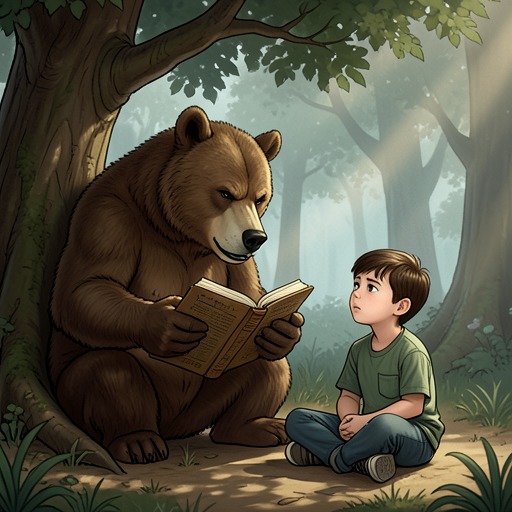
Mowgli and Baloo
The Jungle BookMowgli and Baloo is one of the central educational and emotional relationships in the jungle stories. Baloo, the brown bear who teaches the wolf cubs the Law of the Jungle, accepts responsibility for Mowgli when the Pack Council debates whether a man-cub may belong among the Free People. He does not merely defend Mowgli’s admission: he undertakes to teach him. Through lessons in law, speech, terrain, and restraint, Baloo turns Mowgli’s unusual human vulnerability into practical strength, while Mowgli’s courage, memory, and affection make the old teacher’s duty personal.
Teacher and Pupil
Baloo is the only creature besides the wolves’ own members who is regularly admitted to the Pack Council. His authority rests on knowledge and trust: he eats only nuts, roots, and honey, teaches the young wolves the Law of the Jungle, and is therefore permitted to speak for Mowgli when no wolf initially answers Akela’s question. Baloo’s defense is direct and consequential. He declares that there is no harm in a man’s cub, asks that Mowgli be allowed to run with the Pack, and promises to teach him himself. His intervention supplies the second independent voice required for the cub’s acceptance and makes Mowgli’s place in the Pack legally and socially possible. Baloo’s curriculum is broader than the instruction given to ordinary wolf cubs. The young wolves learn only the parts of the Law that apply to their own pack and tribe, but Mowgli must master the knowledge of several communities because he is a human child living in an animal world. Baloo teaches him how to read the forest and water: how to distinguish a rotten branch from a sound one, how to address wild bees when approaching a hive high above the ground, how to warn water-snakes before entering their pools, and how to speak to Mang the Bat when disturbing him in the branches at midday. He also teaches the Strangers’ Hunting Call, whose meaning is a request for permission to hunt in another group’s territory because hunger requires it, followed by the answer that permits hunting for food but not for pleasure.
Discipline as Protection
Baloo’s teaching is physical as well as verbal. When Mowgli forgets a lesson, the bear strikes him, and Bagheera objects that the child’s face is bruised. Baloo answers that bruises caused by a teacher who loves him are preferable to harm caused by ignorance. The severity is therefore presented not as casual cruelty but as a practical response to the jungle’s dangers: Mowgli must be able to recognize threats too small, hidden, or unfamiliar to be survived through courage alone. The most important part of this education is the Master Words of the Jungle. Baloo teaches Mowgli the formulas that allow him to claim protection from birds, the Snake People, and the animals that hunt on four feet, with the crucial exception of his own pack. Because Baloo cannot pronounce the Snake Word, he obtains it through Hathi the Wild Elephant, who takes Mowgli to a pool to learn it from a water-snake. Baloo takes pride in the result, believing that Mowgli is reasonably safe from snakes, birds, and beasts because he can identify himself through the proper language. The qualification that remains—danger from his own tribe—quietly exposes the limit of instruction: knowledge can establish alliances across species, but it cannot abolish political conflict within the Pack or the wider jungle.
The Bandar-log Crisis
The relationship is strained when Mowgli begins speaking with the Bandar-log, the Monkey People. He repeats their promises that he will be allowed to join them, throw branches and dirt at Baloo, and treat the episode as a new game. Baloo immediately recognizes the danger. His large paw scoops Mowgli from Bagheera’s back, and his anger shows that disobedience is not merely a breach of manners but a rejection of the order that keeps the child alive. Bagheera’s hard expression confirms the seriousness of the offense. When the Bandar-log abduct Mowgli and carry him toward the Cold Lairs, Baloo’s authority becomes desperate responsibility. Bagheera climbs through branches that break beneath his weight, while Baloo abandons his usual measured teaching for a clumsy, urgent pursuit. In grief and fury, Bagheera blames him for failing to warn Mowgli properly, and Baloo can only urge haste. The accusation reveals the painful double edge of their bond: Baloo’s discipline has been intended to protect Mowgli, yet the teacher feels accountable when the pupil is taken despite it. Baloo’s declaration to Kaa makes the attachment explicit. He calls Mowgli the best, wisest, and boldest of man-cubs, identifies him as his own pupil, and admits that he and Bagheera love him. The statement changes the relationship from formal instruction to chosen kinship. Baloo is not pursuing an abstract rule-breaker or merely recovering a useful member of the Pack; he is trying to recover a beloved child whose education has become part of his own identity.
Rescue and Mutual Loyalty
At the Cold Lairs, Baloo arrives after Bagheera has already been surrounded. The bear’s rescue is physically blunt and unmistakable: he throws himself onto the terrace, embraces as many monkeys as he can hold, and strikes them in repeated blows while Bagheera fights toward the water tanks. The rescue is a coordinated answer to the crisis Mowgli’s association with the Bandar-log has caused, but Mowgli is not passive within it. From behind the open work, he watches Bagheera fighting for his life and directs him toward the reservoirs, where the monkeys cannot follow. Mowgli’s cry gives Bagheera new courage, and the struggle continues until Baloo reaches the terrace. When Bagheera, trapped in the tank, calls for protection with the Snake’s Call, the Master Words taught by Baloo become part of the rescue’s emotional and tactical structure. Mowgli’s education has not prevented danger, but it has given him and his allies a shared language through which danger can be met. The lesson returns as action: what Baloo drilled into the child becomes a resource for the entire group. After the rescue, Baloo’s affection does not erase the Law. He refuses to manipulate it merely to spare Mowgli further trouble, although he reminds Bagheera that the child is very young. Mowgli accepts responsibility, admits that he did wrong, and recognizes that Baloo and Bagheera have been wounded. The scene preserves both sides of the relationship: Baloo is a loving guardian, but he is also the teacher whose credibility depends on enforcing the rules he has taught.
Meaning of the Bond
Mowgli and Baloo embody a form of belonging created through instruction rather than blood. Mowgli enters the wolf community as an outsider, and Baloo’s sponsorship gives him a formal place; his lessons then equip him to move among different species and territories. The relationship therefore joins law, care, and survival. Baloo’s rules are not empty commandments: they arise from particular environments, dangers, and encounters, from rotten branches and water-snakes to territorial hunting and the perilous disorder of the Bandar-log. Their bond also shows that law is transmitted through relationships. Baloo does not teach from a distance or as an impersonal authority. He watches, corrects, demonstrates, obtains knowledge from Hathi, praises memory, and accepts responsibility when Mowgli fails. Mowgli, for his part, does not remain merely obedient. He remembers the words under pressure, observes the battle, directs Bagheera toward safety, and helps transform the training he received into practical judgment. The relationship’s decisive significance lies in this reciprocity. Baloo teaches Mowgli how to survive the jungle, but Mowgli gives Baloo a pupil whose difference expands the meaning of the Law beyond the limits of the wolf cubs’ ordinary experience. Their connection begins at the Pack Council as a formal act of sponsorship and develops through correction, danger, rescue, confession, and renewed trust. It is at once a school, a guardianship, and a chosen family bond, proving that in the jungle knowledge becomes protection only when it is carried by loyalty.